
Code Converter
Browser-based multi-language code converter powered by LLMs.
Overview
Problem
Migrating applications from one programming language to another is a complex and time-consuming process. Developers often need to manually rewrite files, preserve project structure, maintain naming conventions, and ensure consistency across large codebases. Existing code translation tools typically focus on individual snippets rather than complete projects, making large-scale migrations inefficient and error-prone.
Solution
Built a browser-based multi-language code conversion platform that enables developers to upload entire projects and convert them across programming languages using Large Language Models (LLMs). The platform preserves project architecture, file organization, and naming conventions while allowing side-by-side comparison of original and converted code. Users can export the generated codebase as a ZIP file and benchmark outputs across multiple AI models.
Tech Stack
Architecture
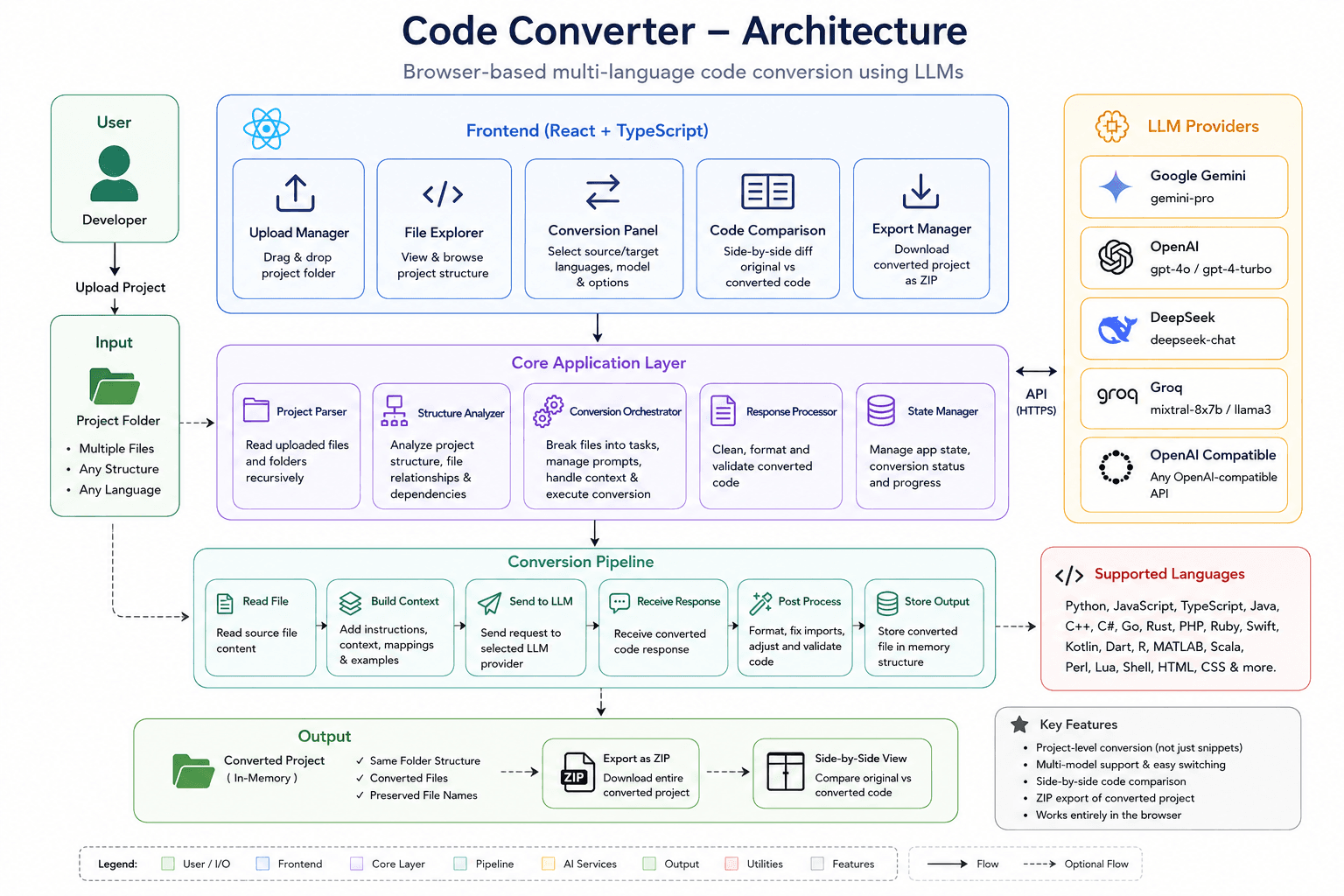
Features
- Upload and convert complete project folders instead of individual code snippets
- Multi-model support with OpenAI-compatible providers including Gemini, DeepSeek, Groq, and others
- Side-by-side comparison of original and converted code
- Project architecture and folder structure preservation during conversion
- ZIP export functionality for downloading converted projects
- Browser-based workflow with no backend configuration required
- Support for 20+ programming languages including Python, Rust, Go, TypeScript, and JavaScript
- Model benchmarking to compare conversion quality across multiple LLMs
Technical Decisions
Used React 19 and TypeScript for type-safe, scalable frontend development
Selected Vite for fast development builds and optimized production bundling
Implemented a provider-agnostic architecture supporting multiple LLM APIs through a unified interface
Performed all configuration in the browser to simplify setup and reduce deployment complexity
Used JSZip and FileSaver for client-side project packaging and downloads
Designed a modular service layer to support future AI providers without major architectural changes
Challenges
- Preserving project structure and file relationships during large-scale codebase conversion
- Managing conversion workflows for multiple files while maintaining performance in the browser
- Handling differences in syntax, architecture patterns, and frameworks across programming languages
- Creating a unified interface that works consistently across multiple LLM providers
- Ensuring accurate side-by-side comparison for large converted projects
Outcomes
- Delivered a full-stack developer productivity tool focused on code migration and language interoperability
- Built a scalable architecture capable of supporting multiple AI providers and future language integrations
- Simplified project-level code conversion through an intuitive browser-based experience
- Demonstrated expertise in TypeScript, React, AI integrations, modular architecture design, and developer tooling